
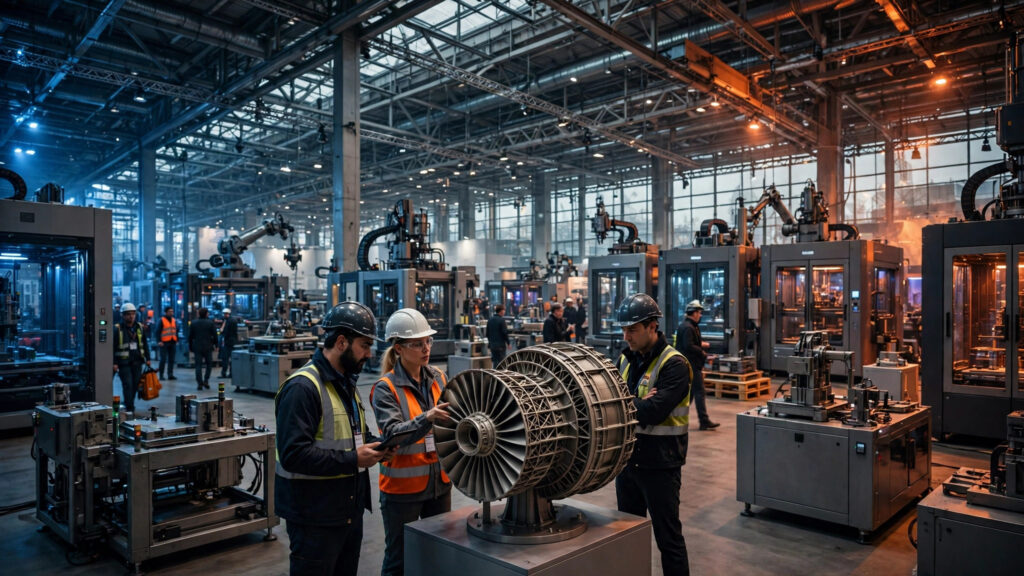
Formnext 2026 preview — Messe Frankfurt, November 17–20
Two weeks ago, our sister site 3D Printing Ventures laid out the numbers in 3D Printing Investments: Why Defense, Not Desktop, Is Driving the Money. The short version: additive manufacturing is a $24.2 billion industry (Wohlers Report 2026), but the growth has moved. AM services grew 15.5% in 2025 while printer sales grew just 3.6%. Defense is now the industry’s leading revenue sector, ahead of aerospace and medical. And Department of War funding for additive manufacturing jumped 83% to $3.3 billion in fiscal 2026.
Next week, that thesis gets its floor test.
Formnext 2026 opens Tuesday, November 17 at Messe Frankfurt, with around 800 exhibitors expected across Halls 11.0, 12.0 and 12.1, and more than 38,000 visitors expected after last year’s record 38,282. It is still the industry’s biggest week. The question is what kind of industry shows up. Here are the three things we’re watching.
1. Production metal is the main event
The headline launch of the show belongs to Nikon SLM Solutions, which unveils its MACHX production platform on Tuesday at 10:00 in Hall 12.0 (Booth D119) — a launch the trade press is already calling the biggest splash of the week. It arrives days after a leadership reshuffle that put co-presidents Jan-Niklas Thielmann and Simone Castellani in charge, and alongside a new partnership with PanOptimization that builds PanX build simulation directly into the Nikon SLM workflow.
Right behind it: ATLIX, the metal AM company carved out of TRUMPF in 2025, announced its xBUILD 5000 on November 12 — a four-laser, 4×1 kW production system. The detail that matters is not the spec sheet. The first production unit is already commissioned at Oerlikon’s Huntersville, USA site, printing for aerospace, defense and semiconductor customers. That is the Ventures thesis in a single sentence: the machine matters less than the qualified production it is already doing.
And at the large-format end, AltForm’s ZENIT modular DED chambers — up to 4×4 metres with four robots, built for reactive alloys like titanium — are aimed squarely at big parts for aerospace, defense and energy. The first chambers are already sold.
2. Qualification is becoming the product
Defense and aerospace buyers don’t buy printers. They buy qualified parts — parts that pass inspection, meet a standard, and can be made the same way the hundredth time as the first. Which is why the most interesting cluster at this year’s show may be the least photogenic: the quality stack.
Four vendors are bringing build simulation, monitoring and quality-data tools to Frankfurt: PanOptimization’s PanX simulation (already used by Nikon SLM), Additive Assurance’s AMiRIS in-situ monitoring, Phase3D’s Fringe Inspection hardware, and amsight’s quality-data platform. Their shared pitch: catch the problem before the build, during the build, or from the data after it — because a failed build in a defense supply chain is not an inconvenience, it’s a missed delivery.
Organizer Mesago has put defense, post-processing and standards at the center of this year’s supporting program. Even the research institutes are on message: Fraunhofer IKTS is showing additively manufactured body armor alongside multi-material aerospace components. When the booth demos are body armor and qualified metal parts, the industry is telling you where its customers are.
3. The floor has a new geometry
The exhibitor map has shifted. The latest count lists 772 exhibitors from 40 countries: Germany still leads with 278, but China is second with 130 — the largest Chinese presence in the show’s history, ahead of France (43), the United Kingdom (39) and the United States (38).
The United Kingdom is this year’s official partner country, with more than 30 UK organisations in the AMUK pavilion — and fresh government money behind it. On November 11, UK Research and Innovation opened a £17.6 million scale-up fund for automotive and aerospace manufacturing with additive named a priority area.
Watch, too, for consolidation signals. ATLIX exists because TRUMPF sold its AM business. Nikon SLM changed leadership a week before its biggest launch. An industry that is concentrating — fewer, larger, production-focused companies — tends to use its biggest trade show to announce what it has become.
The desktop counterpoint
None of this means desktop is dead. Bambu Lab is in Hall 12.1 (Booth G01) with a new machine and Bambu Circle, a programme for users who want to earn income from their printers. Stratasys is giving its large-format F870 its European demo debut alongside a Day 1 machine launch of its own — though note where the F870 points: factory-floor tooling, with Toyota and Rivian already signed on as adopters.
The floor will be busy at both ends. But busy is not the same as funded. The capital, the contracts and the growth rates are at the production end — and production, in 2026, increasingly wears a defense badge.
What we’re watching for by Friday
The test is simple. When the order announcements come out of Frankfurt, count how many carry aerospace and defense names, how many are for production systems rather than prototypes, and how many involve qualification, monitoring or standards rather than a new printer. If the defense boom is real, Formnext’s closing headlines will read like a procurement fair.
We’ll report back when the doors close on November 20.
Preview coverage: launch details via TCT Magazine’s Formnext 2026 preview; exhibitor counts via Mesago Messe Frankfurt and DataOrigin (November 6, 2026). Market figures from Wohlers Report 2026, as cited in the 3D Printing Ventures analysis linked above.