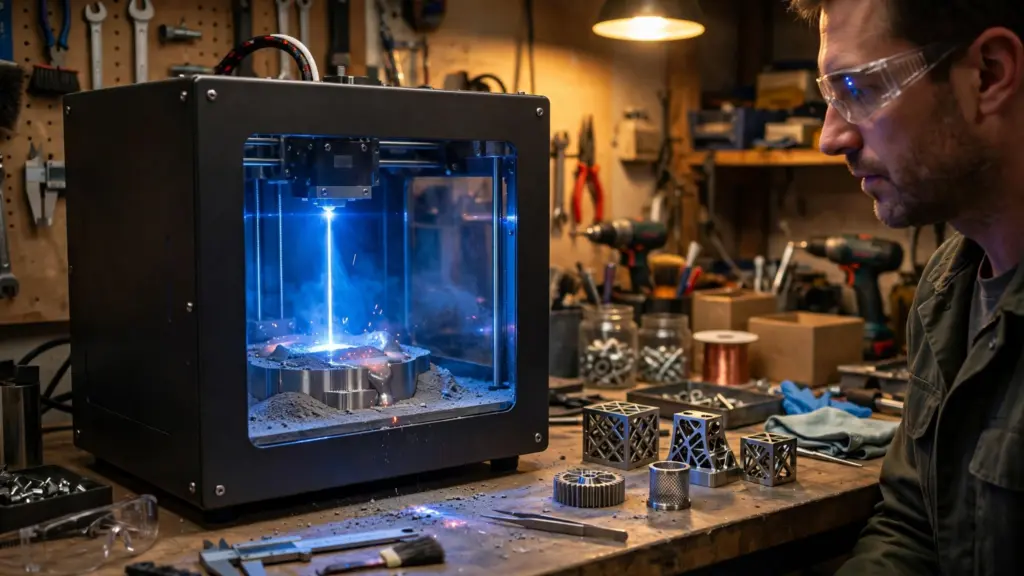
For most of its life, metal 3D printing had a cover charge. If you wanted real laser powder bed fusion — a laser melting real metal powder into real, dense parts — the conversation started around a quarter of a million dollars and went up from there. The machines lived in aerospace plants and medical device factories, behind safety interlocks and serious facilities budgets.
That cover charge just collapsed. This month, market trackers count at least ten companies selling, pre-selling or taking reservations for metal printers small enough to sit on a bench — and four of them advertise prices under $10,000. A Dutch startup, Metal-Base, sells a true LPBF machine, the Metal 1.0, for €9,000. It runs on a standard wall outlet.
The headline is real. So is the catch — several of them, in fact. Here is the new price map, how the price fell this far, and what the brochure leaves out.
The new price map
A recent 3DPrint.com market overview sorts the new low-cost metal LPBF field into three tiers:
- Manual desktop systems, $10,000–$30,000. Metal-Base’s Metal 1.0 at €9,000 (about $9,950) is the flagship of this tier, with kit machines from other startups filling in above it — one popular kit now lists at $14,200, or $17,990 assembled.
- Desktop dental systems, around $40,000. Compact, enclosed machines built for cobalt-chrome dental work, with the workflow handled inside the box.
- Pre-industrial systems, $60,000–$100,000. Machines like Xact Metal’s XM200C, listed around $65,000 in current price guides, with proper fiber lasers and faster scanning.
Above all of that sits the world we covered at Formnext this month, where production systems run from $250,000 into seven figures — and where, as our Formnext verdict piece reported, VulcanForms ordered 200 production metal systems in a single deal. Both stories are true at once: the top of the market is consolidating, and the bottom just fell out.
This wave is also different from the last “cheap metal” moment. The bound-metal filament systems of a few years ago printed metal-filled plastic that needed debinding and furnace sintering — and that era’s best-known vendor ended in a Chapter 11 filing in 2025. The new desktop machines skip the furnace entirely. They fuse powder directly, the same fundamental process as the industrial machines, just smaller and slower.
How the price fell
Three substitutions did most of the work:
- Diode lasers instead of fiber lasers. Metal-Base’s 60 W blue diode laser (445 nm) costs a fraction of an industrial fiber laser, and because metals absorb blue wavelengths efficiently, 60 W is enough to fully melt steel and Inconel powder.
- Gantries instead of galvo scanners. The precision mirror systems that steer a laser across an industrial powder bed are expensive. The cheap machines move the laser on an FDM-style gantry or CoreXY stage — slower, but radically cheaper.
- Open-source software instead of licensed stacks. The Metal 1.0 runs Klipper firmware and slices in OrcaSlicer. No licence fees, no locked parameters — and, as we’ll see, no guardrails either.
Underneath all three sits plain component deflation: lasers, optics and motion hardware have been getting cheaper for a decade, and in 2026 they crossed the line where a capable metal printer could be built around them.
The printer is now the cheapest part of metal 3D printing. Everything that surrounds it still bills like it’s 2019.
Here’s the catch
1. You mostly can’t buy one yet. A November 14 audit of the desktop metal field found that everything under $10,000 is a campaign, a reservation or a pre-order — not one sub-$10,000 production machine could be confirmed in a paying customer’s hands. The cheapest desktop metal printers you can actually order today cost about $33,000 and $39,000. Metal-Base is furthest along, with beta machines at customer sites and Kickstarter units shipping this autumn, but “shipping soon” is doing real work in that sentence.
2. The build volume is a shoebox. The Metal 1.0 builds 128 × 100 mm. Dental crowns, jewellery, brackets, small tooling inserts — yes. The majority of parts a machine shop is asked for — no.
3. The printer is the smallest line item. Budget separately for:
- Metal powder — 316L and Inconel run from tens to hundreds of dollars per kilogram, and you need stock to start
- Inert gas, or a nitrogen generator to replace bottled supply
- Depowdering and sieving equipment to recover unfused powder safely
- Post-processing: stress relief or heat treatment, support removal, surface finishing, and machining for anything with a tolerance that matters
- Safety and compliance: fine metal powder is a respiratory hazard and some alloys are flammable — your insurer and your local fire code will both have opinions
4. The trade-offs are real physics. A diode laser’s beam focuses less sharply than a fiber laser’s, and a gantry moves slower than a galvo scanner. Build times stretch, fine features soften, and the density and strength figures in the brochures are vendor-measured — independent validation is still thin.
5. Cheap to buy is not cheap to qualify. If your customer needs certified parts, the testing and documentation cost what they always cost. A €9,000 printer does not come with a €9,000 qualification pathway.
The insight: this changes who gets to learn, not who gets to produce
It is tempting to read a $9,950 metal printer as a threat to the machine shop. It isn’t — not yet. What it threatens is the outsourcing queue.
The value of a desktop metal printer is iteration speed. A toolroom that prints a steel prototype on Tuesday instead of sending it out for three weeks doesn’t just save money; it runs more design cycles, catches more mistakes, and learns faster than the shop down the road. Dental labs and universities get hands-on LPBF experience that used to require a six-figure budget line. That is the actual disruption: metal printing as a learning tool, priced like a learning tool.
Production is a different game, and it is consolidating at exactly the same moment — the 200-system VulcanForms order and the production platforms in our Formnext launch rundown are where certified, high-volume metal work is heading. The two trends don’t contradict each other. They split the market: learning and iterating move to the desktop, production concentrates in factories, and the middle — the standalone $250,000 machine bought for occasional work — gets squeezed from both sides.
So who should actually buy one?
- Dental labs and jewellers: yes. Small parts, high value per gram, established workflows — the economics already close at the $40,000 tier and improve below it.
- Universities and R&D teams: yes. Open parameters and a standard power outlet make these the first genuinely teachable LPBF machines.
- Toolrooms and job shops: maybe — for small inserts, prototypes and fixtures, with eyes open about post-processing and powder handling.
- Anyone promising certified production parts to regulated customers: not yet. Buy the parts from a qualified service, and revisit when the order books, the validation data and the installed base catch up with the price tags.
Metal 3D printing did just get cheap. What it hasn’t gotten is simple — and the shops that win with these machines will be the ones that budget for the catch, not just the headline.
Go deeper: learn the business side
If you’re weighing a machine purchase — desktop metal or anything else — the buying decision is the easy part. Pricing the work, costing the powder and post-processing, and finding customers who pay for iteration speed is the business. Two resources from our network:
- The 3D Printing MBA — Expanded Edition ($97) — the complete business course: a 236-page Expanded Business Textbook (also provided as six individual volumes), a 65-page Expanded Book, and a 16-page fillable workbook with 68 form fields covering costing, pricing, marketing and launch planning.
- The 3D Printing Starter Kit (free) — the free starting point: what the business actually involves before you spend a dollar on hardware.