
The hardest-working part in engineering is a crystal
Inside a jet engine, the turbine blades live in hell. They spin at more than 10,000 revolutions per minute, in gas hotter than the melting point of the metal they’re made from, under centrifugal forces equivalent to hanging a truck off every blade. They survive because of a trick materials scientists perfected decades ago: each blade is grown as one single crystal — a piece of metal with no internal seams at all.
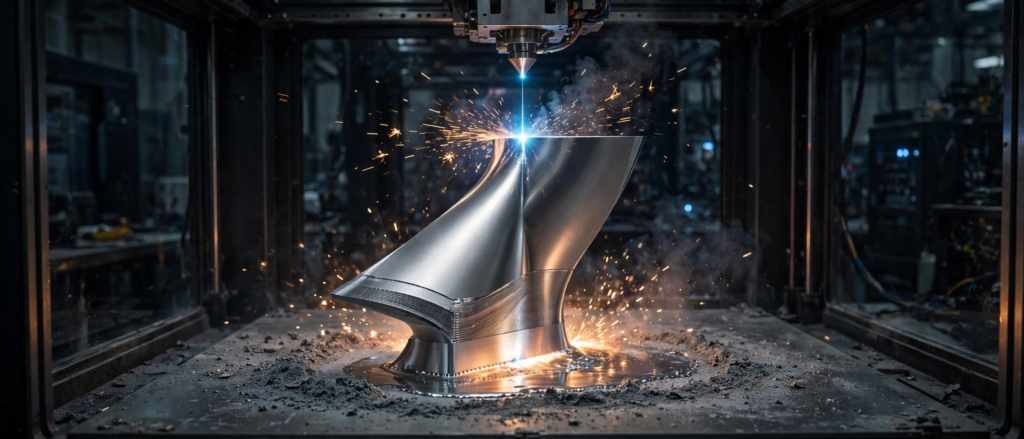
Now, for the first time, researchers have printed one. Layer by layer. A metre long.
The work, reported in Nature by Liu and colleagues, demonstrates an additive manufacturing method that produces single crystals of metals and alloys in complex shapes and at sizes up to one metre — geometries that established crystal-growing methods simply cannot make. And according to Carnegie Mellon materials scientist Gregory S. Rohrer, writing in Nature‘s News & Views, the method runs on readily available equipment.
Why one crystal matters
Almost every metal object you have ever touched is polycrystalline: a patchwork of millions of tiny crystals, called grains, fused together. The seams between them — grain boundaries — are where metal is weakest.
At room temperature, that’s mostly fine. At turbine temperatures, it’s fatal. Grain boundaries slide. They let the metal slowly stretch and deform under load, a failure mode engineers call creep. They are where cracks are born. A turbine blade made of ordinary metal would gradually pull itself apart in the hottest, fastest-spinning section of the engine — the worst possible place for a failure.
Remove the boundaries, and you remove the weakness. A single-crystal blade, cast from a nickel-based superalloy, has no seams to slide, creep, or crack. That’s why single-crystal turbine blades have been standard in high-performance jet engines since the 1980s — and why the same physics makes single crystals essential elsewhere, from the silicon in microprocessors to advanced power-generation turbines.
The old way: grow it slowly, waste most of it
Making a single crystal the traditional way is an exercise in patience and waste. Turbine blades are produced by directional solidification: molten alloy freezes gradually from one end, often through a spiral selector that allows only a single crystal to emerge and grow into the part. The process takes hours, the yields are poor, the shapes are limited to what casting allows, and the crystals that fail inspection become expensive scrap.
Silicon crystals for chips are pulled slowly from a melt, a method commercialized in the 1950s. It works — but “slowly, expensively, and only in simple shapes” has been the state of the art for seventy years.
The breakthrough: print the crystal
3D printing metal normally does the opposite of crystal growing. Rapid melting and solidification freezes metal into exactly the fine-grained patchwork that turbine engineers avoid. Printed parts are versatile, but at extreme temperatures they can’t match a single crystal.
Liu and colleagues have closed that gap. Their additive process builds a part layer by layer while keeping the entire structure one continuous crystal — no grains, no boundaries — and they demonstrated it at scales up to a metre in length, in complex, “architected” shapes that casting-based growth cannot produce.
Three things make this a breakthrough rather than an incremental step:
Scale. A metre-long single crystal is not a laboratory curiosity. It’s the size class of real industrial components — turbine hardware, power-generation parts, structural elements.
Shape. Complex geometries are precisely what casting and crystal-pulling can’t do. If a single crystal can be printed, it can be printed with internal features, curves, and architectures designed for performance rather than for manufacturability.
Equipment. The method uses readily available additive manufacturing hardware. This isn’t a one-off machine in a national lab — it’s a process other labs and manufacturers can replicate and build on.
What it means for jet engines
Start with design freedom. Modern turbine blades already contain intricate internal cooling channels — engineers keep blades alive in gas hotter than their melting point by flowing cooler air through and over them. Casting limits how elaborate those channels can be. A printed single crystal removes the casting constraint: blades could be designed around aerodynamics and cooling physics alone.
Then there’s iteration. Developing a new blade today means new molds, new casting runs, and long waits for testable hardware. Printing collapses that cycle — design, print, test, redesign — the same acceleration additive manufacturing brought to ordinary parts, now arriving for the most demanding parts in the engine.
And the implications run past aviation. Land-based gas turbines for power generation face the same heat and creep limits and use the same class of alloys. Anywhere a component must be strong, hot, and seam-free, a printable single crystal is a candidate.
The honest limits
This is a research result, not a production line. Three caveats matter:
Qualification is brutal. Flight-critical engine parts undergo years of testing and certification. A new manufacturing process restarts much of that clock, however good the early results look.
The details still matter. Which alloys print as clean single crystals, how the printed crystals’ high-temperature properties compare with cast ones across thousands of hours, and how fast the process runs will decide whether this becomes a factory technology or stays a landmark paper.
Scale-up is unproven. One metre in the lab is not ten thousand blades a year on a schedule airlines can depend on. That gap has humbled many promising processes before.
None of that diminishes the result. Every production technology in the engine — including single-crystal casting itself — started as exactly this: a demonstration that the physics works.
The bottom line
For seventy years, if you wanted a large single crystal of metal, you grew it — slowly, expensively, in the few shapes nature and casting allowed. Liu and colleagues have shown you can print one instead: a metre of seamless, boundary-free metal, built layer by layer on ordinary equipment.
The jet engine’s most extreme component just met the most flexible manufacturing method ever invented. Engines will never be the same.
Sources: Liu, C. et al. “Additive manufacturing of ultralong and architected single crystals,” Nature (2026), DOI: 10.1038/s41586-026-11185-0; Rohrer, G. S. “Large-scale single crystals printed layer by layer,” Nature News & Views (21 Oct 2026), nature.com/articles/d41586-026-03257-y.
Related: MIT 3D-Printed an Electric Motor. Could Spare Parts Become Downloads?