

AI Is Transforming 3D Printing: The Rise of Intelligent Manufacturing
For decades, the biggest limitations in manufacturing were not the machines themselves—they were the time, expertise, and cost required to design products, optimize performance, and prepare them for production. Today, artificial intelligence is changing that equation.
At major additive manufacturing events around the world, including industry-leading trade shows and conferences, one theme has emerged above all others:
Artificial Intelligence is becoming the brain behind the next generation of 3D printing.
The convergence of AI and additive manufacturing is creating a future where products can be imagined, designed, tested, optimized, and manufactured faster than ever before.
From Design Software to Intelligent Design Systems
Traditional product development often requires:
- Engineering expertise
- CAD modeling skills
- Multiple design iterations
- Physical prototyping
- Extensive testing
AI is dramatically reducing these barriers.
Modern generative design systems allow engineers and creators to define goals such as:
- Strength requirements
- Weight targets
- Material constraints
- Manufacturing methods
- Cost limitations
The AI then generates hundreds or even thousands of optimized designs that a human engineer may never have considered.
The result is often lighter, stronger, and more efficient products that are perfectly suited for additive manufacturing.
AI-Powered Generative Design
One of the most exciting developments is generative design.
Instead of drawing a product manually, users define objectives and allow AI algorithms to create optimized structures automatically.
Applications include:
- Aerospace components
- Medical implants
- Automotive parts
- Consumer products
- Robotics
Many AI-generated designs resemble structures found in nature, utilizing organic geometries that minimize material while maximizing strength.
These complex shapes are often impossible to manufacture using traditional methods but can be produced easily through 3D printing.
Automated Engineering Workflows
AI is also transforming engineering itself.
Advanced systems can now:
- Analyze structural integrity
- Predict failure points
- Optimize support structures
- Recommend materials
- Simulate real-world performance
Tasks that once took engineers days or weeks can now be completed in minutes.
This allows organizations to:
- Launch products faster
- Reduce development costs
- Improve quality
- Accelerate innovation
Print Optimization and Quality Control
Successful 3D printing requires precise control of numerous variables:
- Temperature
- Layer height
- Print speed
- Material flow
- Cooling rates
AI systems can continuously monitor these variables and make real-time adjustments.
Benefits include:
- Fewer failed prints
- Better surface finishes
- Improved dimensional accuracy
- Reduced material waste
Machine learning algorithms are increasingly capable of identifying defects before they occur, saving both time and money.
Predictive Maintenance
Industrial 3D printers represent significant investments.
Unexpected downtime can be costly and disruptive.
AI-driven predictive maintenance systems monitor:
- Machine vibrations
- Temperature changes
- Component wear
- Performance metrics
These systems can identify potential failures before they happen, allowing maintenance teams to act proactively rather than reactively.
The result is:
- Higher uptime
- Lower repair costs
- Greater productivity
The Rise of Autonomous Print Farms
Perhaps one of the most transformative developments is the emergence of autonomous print farms.
These facilities use AI and robotics to manage:
- Print scheduling
- Job prioritization
- Material handling
- Quality inspection
- Production tracking
Human involvement becomes minimal.
Instead, intelligent systems coordinate hundreds or thousands of printers operating simultaneously.
This creates the foundation for:
Manufacturing at software speed.
Design Once, Manufacture Anywhere
One of the most powerful concepts emerging from AI-driven manufacturing is the idea of:
“Design Once, Manufacture Anywhere”
In this model:
- A product is designed digitally.
- AI optimizes the design.
- The design is distributed globally.
- Production occurs locally.
A product created in Denver could be manufactured instantly in:
- Tokyo
- Berlin
- Sydney
- Dubai
without shipping inventory across the globe.
This model reduces:
- Transportation costs
- Inventory requirements
- Supply chain risk
- Carbon emissions
while dramatically increasing manufacturing flexibility.
Why This Matters for Small Businesses
Historically, advanced manufacturing was dominated by large corporations with significant engineering resources.
AI is leveling the playing field.
Small businesses can now access:
- AI-assisted design
- Automated production workflows
- On-demand manufacturing
- Global digital distribution
This allows startups and independent creators to compete in ways that were previously impossible.
A single entrepreneur with an idea can increasingly leverage AI and 3D printing to bring products to market without massive capital investments.
The Future: AI + Robotics + Additive Manufacturing
The future of manufacturing is not simply about better printers.
It is about creating intelligent manufacturing ecosystems where:
- AI designs products
- Robotics manage production
- 3D printers manufacture components
- Sensors monitor quality
- Autonomous systems optimize operations
The factory of the future may resemble a highly coordinated digital organism rather than a traditional manufacturing plant.
Looking Ahead
The convergence of AI and 3D printing represents one of the most significant technological shifts in modern manufacturing.
As AI continues to improve, we can expect:
- Fully autonomous print farms
- AI-generated products
- Self-optimizing factories
- Hyper-personalized manufacturing
- Decentralized production networks
For the 3D printing industry, this is more than an incremental improvement.
It is the beginning of a new era where manufacturing becomes intelligent, adaptive, and globally distributed.
The companies that successfully combine AI, additive manufacturing, robotics, and digital distribution may define the future of how the world designs and produces everything from consumer goods and medical devices to homes, vehicles, and eventually even bioprinted organs.
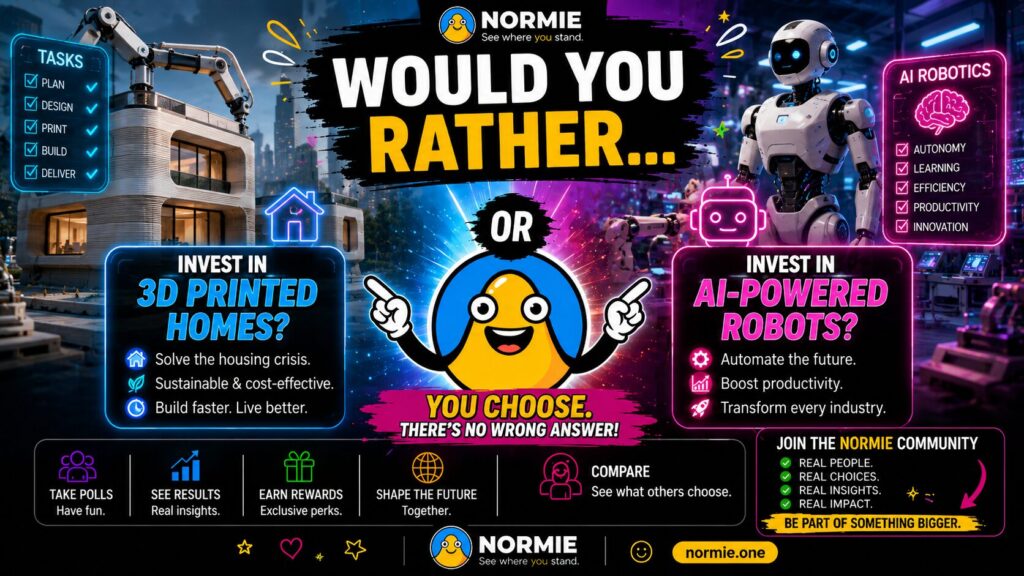
Would You Rather: Invest in 3D Printed Homes… OR Invest in AI-Powered Robots?
Imagine you are given two opportunities that could potentially define the next decade of technological innovation.
On one side is the rapidly growing world of 3D printed homes—robotic construction systems that promise to build houses faster, cheaper, and more sustainably than traditional methods.
On the other side is the explosive rise of AI-powered robots—intelligent machines capable of performing physical and cognitive tasks that were once the exclusive domain of humans.
So the question is:
Would You Rather…
Invest in 3D Printed Homes…
OR
Invest in AI-Powered Robots?
At first glance, both opportunities appear incredibly attractive. Both are fueled by advances in artificial intelligence, automation, and digital manufacturing. Both have the potential to disrupt trillion-dollar industries. And both could dramatically reshape the future of work, housing, and economic productivity.
But which has the greater upside?
The Case for 3D Printed Homes
The global housing shortage continues to worsen.
Many countries face:
- Rising construction costs
- Skilled labor shortages
- Increasing demand for affordable housing
- Aging infrastructure
3D printing offers a compelling solution.
Large-scale robotic printers can create walls and structural components in a matter of days rather than months. Companies are already building entire neighborhoods using additive manufacturing technologies.
Potential benefits include:
- Lower construction costs
- Faster project completion
- Reduced material waste
- Greater design flexibility
- Improved sustainability
If 3D printed housing reaches mainstream adoption, it could transform one of the largest industries on Earth.
The global real estate market is worth hundreds of trillions of dollars.
Even capturing a small portion of that market could create enormous value.
The Case for AI-Powered Robots
Now consider AI-powered robots.
Unlike traditional robots that perform repetitive tasks, modern AI robots can increasingly:
- Understand natural language
- Learn from experience
- Navigate dynamic environments
- Make decisions autonomously
- Perform complex physical tasks
These machines are beginning to enter:
- Warehouses
- Factories
- Hospitals
- Restaurants
- Retail environments
- Homes
Some analysts believe AI-powered robotics could become the largest technology revolution since the internet.
Why?
Because labor is one of the largest costs in nearly every industry.
If intelligent robots can perform meaningful work at scale, the economic impact could be measured in tens of trillions of dollars annually.
In this scenario, robots don’t just transform one industry.
They transform all industries.
A Deeper Question
This debate is about more than investing.
It reflects two very different visions of the future.
The 3D printed homes path asks:
How do we solve humanity’s need for shelter?
The AI-powered robot path asks:
How do we solve humanity’s need for labor?
One addresses where we live.
The other addresses how we work.
Both are fundamental human challenges.
The Hidden Connection
Interestingly, these technologies may not be competitors at all.
In fact, they may become partners.
Future construction sites could feature:
- AI-driven design systems
- Autonomous construction robots
- Large-scale 3D concrete printers
- Real-time optimization algorithms
- Self-managing building projects
In other words:
AI-powered robots may be the very thing that accelerates the adoption of 3D printed homes.
The future may belong to companies that combine both technologies into a single intelligent construction ecosystem.
The Bigger Picture
History shows that the greatest fortunes are often created by investing in infrastructure technologies that enable entirely new economic systems.
Railroads enabled industrialization.
The internet enabled digital commerce.
Artificial intelligence and advanced manufacturing may enable the next economic revolution.
Whether that revolution is led by robotic builders creating entire cities or intelligent robots transforming every workplace remains to be seen.
But one thing is becoming increasingly clear:
The future will likely be built by machines.
The question is whether those machines will spend more time building houses—or doing everything else.
What’s Your Choice?
Would You Rather…
🏠 Invest in 3D Printed Homes…
OR
🤖 Invest in AI-Powered Robots?
Your answer may reveal more than your investment preferences.
It may reveal how you envision the future itself.
What would YOU choose?
Join the conversation on Normie and discover how your answers compare to thousands of others. Explore personality polls, behavioral insights, rewards, and thought-provoking debates about the future of humanity, AI, technology, health, and more.
See where you stand. 🚀💙💛